
SAI teams claim top honors at national embedded chip competition
作者: yl7703永利官网 日期: 2026/09/21At the national finals of the 9th National Collegiate Embedded Chip and System Design Competition, teams from School of Artificial Intelligence (SAI), Shenzhen Technology University (SZTU) competed against top universities including Harbin Institute of Technology, Southeast University, University of Electronic Science and Technology of China and Beihang University. The teams brought home two national first prizes, three second prizes and two third prizes. Faculty advisors Prof. Li Meng and Associate Prof. Ning Lei were awarded the Excellent Organization Award of the contest.
Hosted by the China Electronic Education Association, the National Collegiate Embedded Chip and System Design Competition is a highly-prestigious national-level discipline contest in electronics, artificial intelligence and embedded systems. For this edition, 15 leading domestic and international chip enterprises co-designed competition topics focusing on cutting-edge fields such as artificial intelligence, edge computing and embedded intelligent robots. Combining on-site demonstration and comprehensive defense, the contest evaluates students’ comprehensive capabilities in software-hardware development, system architecture design, engineering implementation and innovative practice.
This year set a new record for competition scale. It attracted 17,000 teams consisting of 44,500 students from 908 universities across 33 provincial-level administrative regions in China and overseas. After rigorous selection at university and regional divisions, 1,227 teams advanced to the national finals.
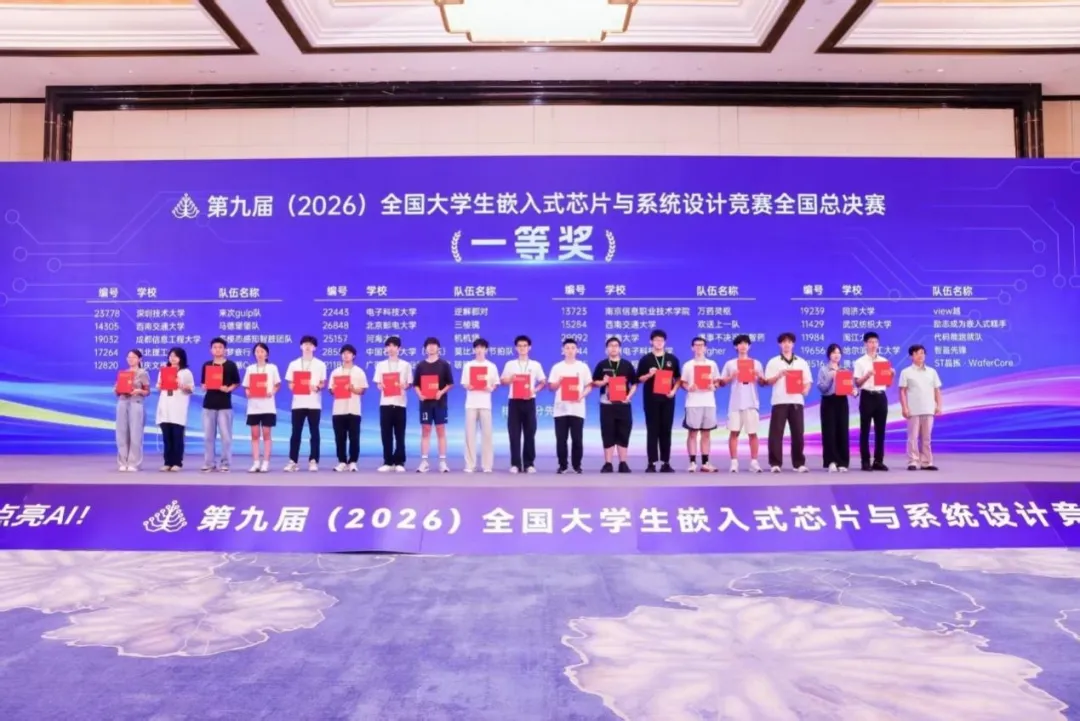
National First Prizes [Photo/School of Artificial Intelligence]
The awarded projects cover popular tracks including intelligent sensing, embedded terminals and edge-AI control systems. Centered on practical demands from daily life and industry, these works balance technical creativity and practical implementation value.
1. Smart Conference Room System Based on OpenHarmony and RISC-V
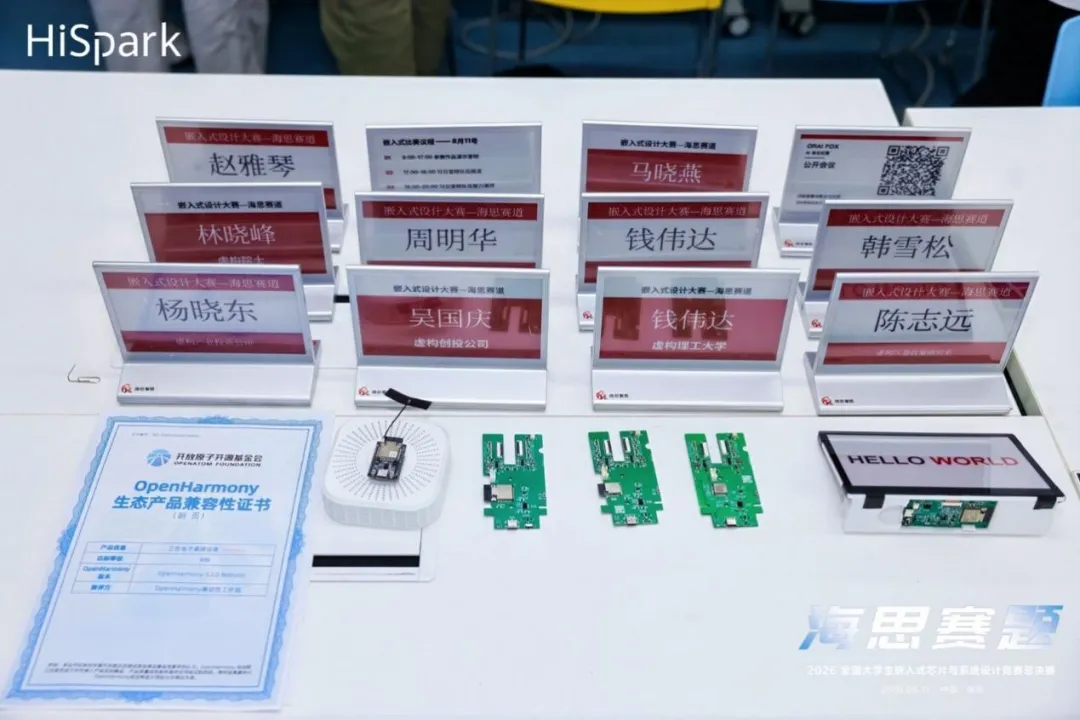
National First Prize Project [Photo/School of Artificial Intelligence]
This project delivers an integrated hardware-software smart conference room system built on OpenHarmony and RISC-V architecture. It integrates tri-color e-ink smart nameplates and cross-platform central control applications, supporting StarFlash and Bluetooth communication, template editing, device management and batch configuration distribution. Featuring dual-sided information display, minute-level batch deployment and flexible on-site updates, the system solves pain points of traditional paper nameplates such as inconvenient modification and resource waste. With low power consumption, reusability and efficient management, it fits scenarios including government-enterprise meetings, exhibitions, hotel banquets and education-training events, enabling intelligent and low-carbon upgrades for conference management.
2. WS63‑based Wireless Data Transmission System for Power Equipment
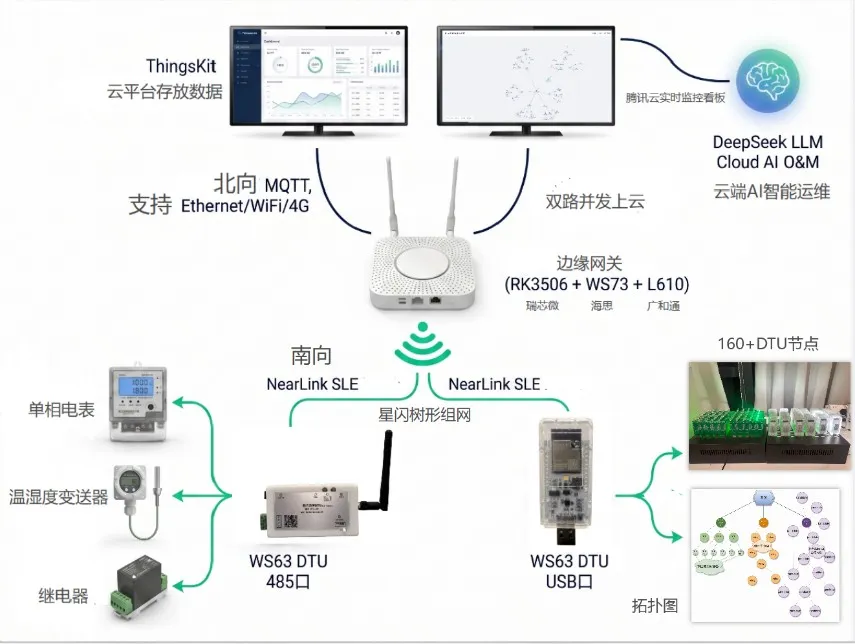
National First Prize Project [Photo/School of Artificial Intelligence]
Targeting drawbacks of traditional RS485 power-industry devices including complicated wiring, poor expandability and high maintenance costs, this project implements a StarFlash-based wireless data transmission system for power equipment. Centered on StarFlash DTU modules, the system connects Modbus RTU devices such as single-/three-phase electric meters, temperature-humidity transmitters and relays. It builds multi-level wireless networks with root, relay and leaf nodes to realize stable data collection, reliable forwarding and wide-range coverage at power sites.
Users can configure nodes conveniently via Bluetooth, QR-code scanning or serial-port web pages for rapid deployment and parameter delivery. Edge gateways aggregate, compress and analyze multi-node data before uploading information to the cloud. Supported by AI models, the system conducts trend analysis, abnormality alerts and linkage protection. It avoids high service fees and fragmented management caused by independent 4G-DTU cloud access. Suitable for power cabinet monitoring, multi-meter data collection and power cabinet status tracking, the system boasts great engineering value and promotion potential.
The competition offers a key platform for students to translate technical knowledge into practical solutions. Moving forward, SAI will keep promoting interdisciplinary training, encourage innovation combining hardware design with artificial intelligence, and nurture practice-focused talents for the industry.
Written by LIN Junzhong / School of Artificial Intelligence, Class of 2029
Reviewed by YAO Qi / School of Artificial Intelligence